
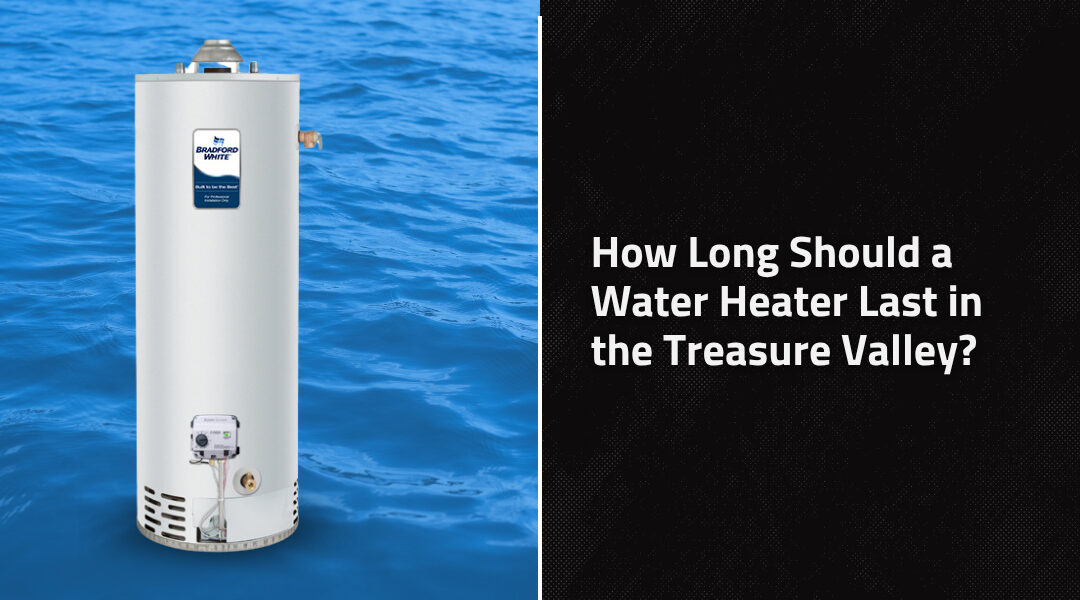
It is the kind of question that does not usually cross a homeowner’s mind until the morning the shower runs cold. Somewhere between the rust-colored puddle on the garage floor and the cost of an unplanned replacement, most Boise homeowners realize they have no idea how old their water heater actually is, much less how much life it has left. The honest answer to the lifespan question is that it depends, and the biggest variable in the Treasure Valley is something most homeowners are not even thinking about: our water.
The standard industry answer for a traditional tank-style water heater is eight to twelve years. Tankless units can run fifteen to twenty. Hybrid heat pump water heaters tend to land somewhere in the middle. Those numbers are accurate national averages, but they assume reasonably soft water and average use. Here in Boise, Meridian, Nampa, and Caldwell, neither of those assumptions tends to hold true.
Why Treasure Valley Water Is Hard on Water Heaters
Most of the valley sits on water that runs between moderately hard and very hard, depending on where you live and whether you are on city or well water. That mineral content is not dangerous to drink, but it is brutal on a water heater. Every time your tank cycles, those minerals precipitate out of the water and settle on the bottom of the tank as scale. Over the years, that sediment builds up into a thick, insulating crust that forces the burner or heating elements to work longer and hotter to heat the water above it. Higher operating temperatures mean accelerated corrosion of the tank liner and a sacrificial anode rod that gets eaten up faster than it would in a softer-water market.
Translation: a tank water heater installed in Eagle or Kuna without any treatment may give you eight to ten years if you are lucky, even if the manufacturer rates it for twelve. We see units come out of service at year seven all the time.
Signs Yours Is Getting Close
A water heater rarely fails without warning. The trick is knowing what to listen and look for. Rumbling, popping, or kettling sounds from the tank are a classic sign of heavy sediment buildup. Rust-tinted hot water, especially first thing in the morning, suggests the tank is corroding from the inside out. Pooling water around the base of the unit is your final warning, and at that point replacement is no longer optional. A drop in hot water capacity, where the shower that used to run twenty minutes now goes lukewarm at twelve, is another red flag that something has changed inside the tank.
The Single Best Way To Get More Years Out of Your Tank
If there is one piece of advice that genuinely extends water heater life in the Treasure Valley, it is an annual flush. Draining the sediment out of the bottom of the tank once a year stops the cycle that kills these units. Without that layer of mineral scale insulating the burner, the heating elements run cooler, the anode rod lasts longer, and the tank liner is not constantly being baked from below. We routinely see flushed, maintained tanks make it to year twelve or thirteen in homes where the neighbor’s unflushed unit died at year eight.
The catch is that almost nobody actually does it. An annual tank flush is one of those maintenance tasks that lives on the to-do list and never quite gets crossed off, and the consequence shows up years later as a premature replacement.
This is exactly why we built the Drake Duck Club. Members get an annual water heater flush and inspection included as part of their plumbing maintenance, along with priority scheduling and member-only pricing on repairs. For homeowners on hard water, which is most of the Treasure Valley, the math works out heavily in your favor: a few years of membership often costs less than a single early water heater replacement. The plumbing tier covers the flush along with a full annual inspection of your home’s plumbing system, and the whole house tier folds in HVAC maintenance on top of it.
Other Things You Can Do
Beyond the annual flush, replacing the anode rod every three to five years gives the tank’s interior something to corrode besides itself. If your home does not already have one, adding a water softener is one of the most impactful upgrades you can make for the entire plumbing system, water heater included. Soft water dramatically slows scale buildup throughout the house, from the water heater to the dishwasher to every faucet aerator.
When Repair Stops Making Sense
If your unit is past the ten-year mark and needs a significant repair, replacement is usually the smarter call. Newer units, whether you go with a high-efficiency tank, a tankless model, or a hybrid heat pump water heater, will pay you back in lower operating costs and a fresh warranty. Tankless in particular is worth a look for households tired of running out of hot water, since it heats on demand and tucks away into a fraction of the space a tank takes up.
Not sure where yours stands? Give us a call at (208) 362-6200 or request service online and one of our techs can take a look, check the age and condition, and give you a straight answer about whether you have years left or it is time to start planning. And if you want to stop guessing year after year, ask about joining the Drake Duck Club while the tech is on site. Fast. Friendly. Fixed. Just Drake it.
Discover more from Drake Mechanical
Subscribe to get the latest posts sent to your email.