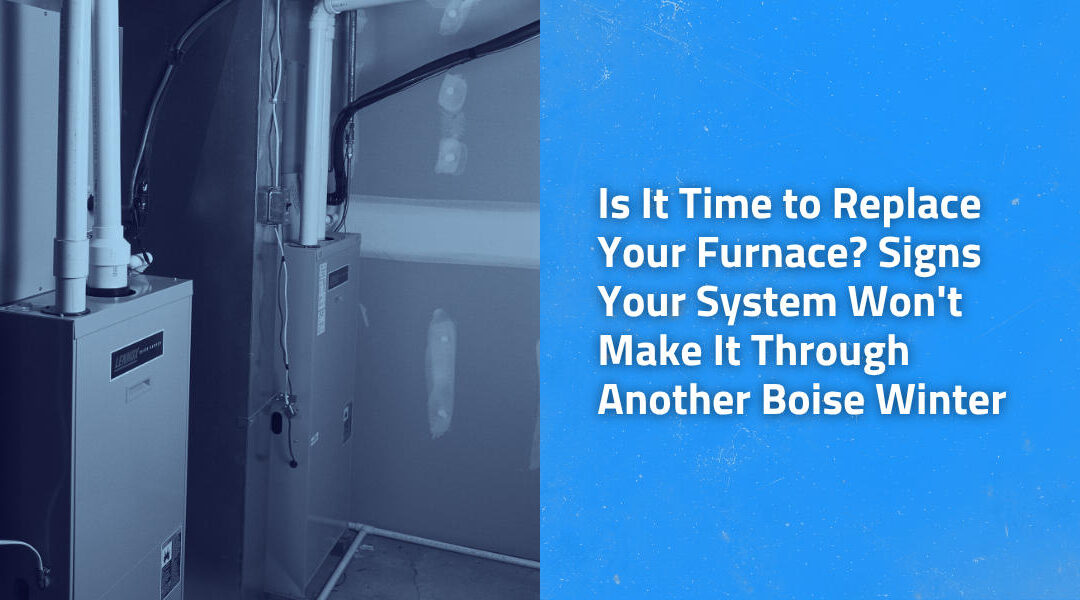
Every fall in the Treasure Valley, there is a specific kind of dread that sets in the first time the furnace kicks on for the season. It is that moment of listening a little too closely, half expecting a strange noise or a smell that was not there last year. If your furnace made it through that first startup without incident, that is a good sign. If it did not, or if this is not the first year you have had that nagging feeling, it might be time to have an honest conversation about whether repair or replacement is really the right call.
Furnaces do not usually fail all at once. They send signals for a season or two before the real trouble starts, and most homeowners either miss those signals or talk themselves out of acting on them. Knowing what to actually watch for makes the decision a lot easier, especially before you are standing in a cold house in January wishing you had dealt with it in September.
Age Is the Starting Point, Not the Whole Story
Most furnaces are built to last somewhere between fifteen and twenty years, though that range shifts depending on maintenance history, how hard the system has worked over its lifetime, and the quality of the original installation. If your furnace is pushing past fifteen years, age alone is a reason to start planning, even if it is still technically running fine today. A furnace does not need to be broken to be worth replacing. It just needs to be old enough that the odds of a major failure are climbing every winter you keep it.
The Treasure Valley’s temperature swings, hot dry summers followed by genuinely cold winters, put a fair amount of stress on heating equipment. A furnace working through that kind of range for fifteen-plus years has earned some skepticism, even if nothing has gone wrong yet.
Rising Repair Frequency Is the Clearest Signal
If your furnace needed a repair call last winter and another one already this fall, that pattern tends to continue and worsen. Furnaces do not usually have one problem and then behave for years afterward. Once components start failing, more failures tend to follow as the system ages, and the repair bills start adding up in a way that eventually rivals the cost of a new system entirely. If you find yourself calling for furnace repair more than once a season, that repeated pattern is often a stronger signal than any single symptom.
Rising Energy Bills Without a Clear Reason
A furnace losing efficiency as it ages will often show up on your gas bill before it shows up as an outright failure. If your heating costs have crept up over the past couple of winters without any real change in usage or weather patterns, the furnace is likely working harder than it used to just to produce the same amount of heat. Older systems, especially those without variable-speed blowers or modulating burners, lose efficiency gradually in a way that is easy to miss month to month but obvious when you compare bills across a few years.
Uneven Heating Throughout the House
If some rooms stay comfortably warm while others never quite get there no matter how long the furnace runs, that unevenness is often a sign the system is struggling to keep up with the demand placed on it. This can point to a furnace that was undersized for the home to begin with, or one that has lost enough capacity over the years that it can no longer heat the whole house evenly. Either way, a system straining to reach every room is a system working harder than it should.
Strange Sounds, Smells, or Short Cycling
Banging, rattling, or screeching sounds that were not present in past seasons often point to mechanical wear inside the unit. A burning smell beyond the brief, expected scent of dust burning off during the first startup of the season is worth taking seriously. And a furnace that short cycles, turning on and off repeatedly rather than running a normal heating cycle, is often struggling with a component that is failing or already gone. None of these are things to wait out.
When a Repair Stops Making Sense
The rule of thumb we use with customers is straightforward. If a single repair would cost more than roughly a third to half the price of a new furnace, or if the unit has already needed multiple repairs in recent years, replacement is usually the smarter long-term decision. A newer furnace also brings real efficiency gains that older systems simply cannot match, which means part of the replacement cost comes back to you every winter through lower gas bills.
Why Now Is a Good Time to Make the Decision
If your furnace has been giving you any of these warning signs, right now is a good window to deal with it. We currently have $350 off a new furnace, which makes replacing an aging or failing system considerably more approachable, and getting it handled now means avoiding the scheduling crunch that hits every HVAC company in the valley the moment the first hard freeze arrives. Financing is also available with $0 down and payments as low as $35 a month, so a planned replacement does not have to mean a large upfront hit.
Get a Straight Answer
If you are not sure whether your furnace has another winter in it, the smartest move is to have a technician actually look at it rather than guess. We will give you an honest assessment of where the system stands and walk you through the numbers on repair versus replacement without any pressure toward the more expensive option.
Give us a call at (208) 362-6200 or request service online to get it looked at before the cold really sets in. Fast. Friendly. Fixed. Just Drake it.
Discover more from Drake Mechanical
Subscribe to get the latest posts sent to your email.