Most Treasure Valley homeowners remember the first hard freeze of the year the same way. They wake up to frost on the windshield, think “I should have done something about the hose,” and then go to work. Usually nothing happens. Every few winters, though, a cold snap lands harder than expected, and a burst pipe turns an ordinary morning into a flooded crawlspace and an insurance claim.
A frozen pipe is one of the most preventable plumbing emergencies there is, and the prevention work takes an afternoon. With the cold now close, this is the right week to do it.
Why Pipes Freeze (and Why They Burst)
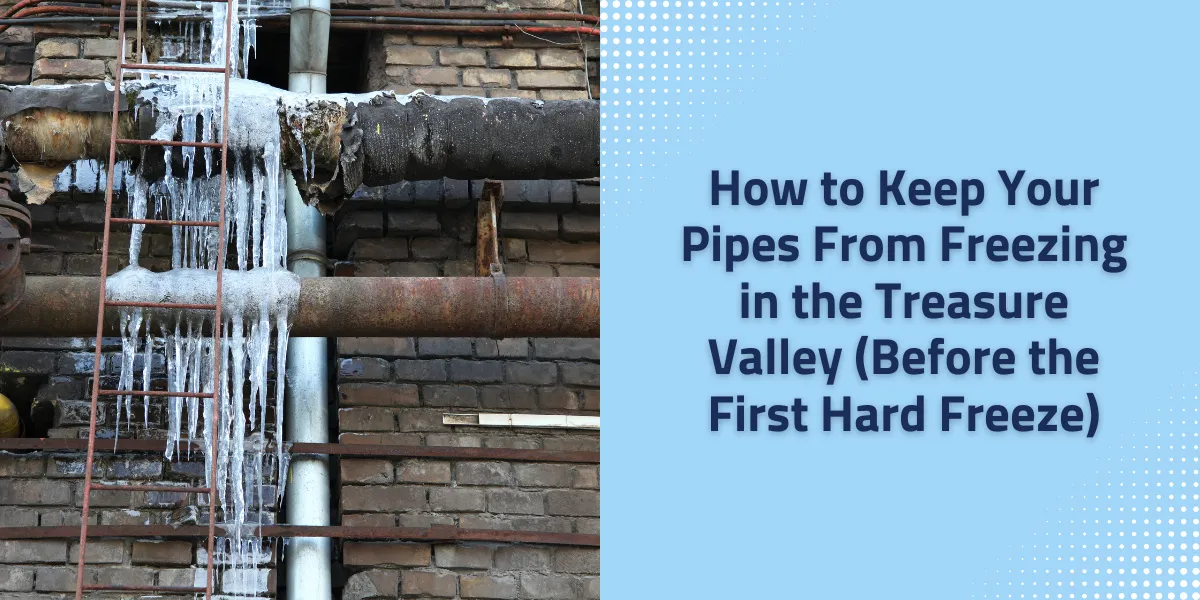
Water expands as it turns to ice. When it freezes inside a pipe, the ice itself is rarely what does the damage. The real problem is the pressure that builds between the ice blockage and the closed faucet downstream. That pressure has nowhere to go, so the pipe splits, often at a spot you cannot see. You will not know anything is wrong until the ice thaws and the water starts moving again, which is why many burst pipes are discovered in the afternoon after a freezing night.
Pipes usually start to freeze when temperatures sit in the low twenties or below for several hours, especially if wind is hitting an exposed wall. The Treasure Valley gets plenty of nights like that, and the places most at risk are the ones you rarely look at: exterior walls, unheated garages, attics, and crawlspaces. Many homes across Boise, Meridian, Nampa, and Caldwell run their supply lines through crawlspaces, where a gap in insulation or a loose vent cover can let in enough cold air to freeze a line near the foundation wall.
Start Outside With the Hose Bibbs
Outdoor faucets are the most common freeze casualty, so begin there. Disconnect every hose, splitter, and sprinkler attachment. A hose left connected traps water inside the faucet and the pipe behind it, and that trapped water is what freezes and splits the line inside the wall. Even frost-free hose bibbs rely on the hose being removed so they can drain properly.
If your home has an interior shutoff for an outdoor faucet, close it and open the outside valve to let the line drain. A foam faucet cover is cheap and adds a little protection on the coldest nights. If a bibb dripped or sprayed behind the handle all summer, replace it now, because a worn faucet is much more likely to fail in the cold.
Look at the Places You Never See
Next, walk through the garage, crawlspace, and any unheated utility area. You are looking for supply lines that run along exterior walls or sit near vents, gaps around where pipes enter the house, and insulation that has slipped or gone missing. Foam pipe sleeves are inexpensive and easy to install, and sealing air leaks near pipes can matter as much as the insulation itself. Keep the garage door closed on the coldest nights, particularly if water lines run through the garage.
Inside the house, the pipes under kitchen and bathroom sinks on exterior walls are the next most vulnerable. On very cold nights, open those cabinet doors so warm air can reach them.
What to Do on a Freezing Night
When the forecast drops into the teens, let a faucet served by an exposed line drip slowly. Moving water is much harder to freeze, and the small amount you waste is far cheaper than a repair. Keep your thermostat set no lower than 55 degrees even if you are away, since a cold house is where frozen pipes start.
Everyone in the household should also know where the main water shutoff is and how to close it. If a pipe does burst, shutting off the water in the first minute can be the difference between a small mess and a major one. If your main shutoff is hard to reach, stuck, or missing, an emergency shut-off valve is worth installing before you need it.
If a Pipe Freezes Anyway
If a faucet runs slowly or not at all in freezing weather, a frozen line is likely. Leave the faucet open, and warm the pipe gently with a hair dryer or heating pad, starting near the faucet and working back toward the frozen section. Never use an open flame, a torch, or a heat gun, which can damage the pipe or start a fire. If you see a bulge, a crack, or water where there should not be any, shut off the main and call a professional right away. Our team handles plumbing repairs of every size, and we are available around the clock for emergencies, including the middle of a freezing night.
Get Ahead of the First Freeze
A quick check now beats a cleanup in January. If you are not sure whether your pipes are protected, or you would like a technician to look at the vulnerable spots in your home, give us a call at (208) 362-6200 or request service online. Fast. Friendly. Fixed. Just Drake it.