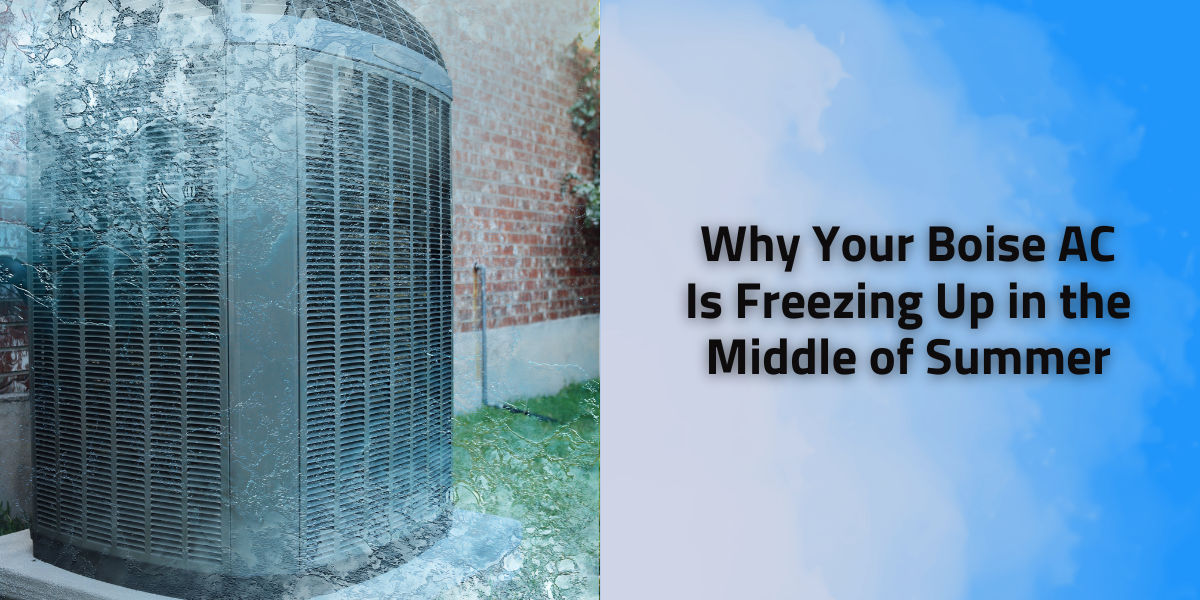
There are few HVAC problems more counterintuitive than an air conditioner that has literally frozen solid on a 100-degree day in Boise. You walk over to a vent expecting a strong stream of cool air, and instead you get a weak trickle. Head down to the furnace and there it is: the evaporator coil sitting above the furnace, encased in ice, blocking the airflow the blower is trying to push through it. Inside, the vents are barely moving air, the house is not cooling, and the whole thing feels like a cruel joke.
It happens more often than most Treasure Valley homeowners realize, and it almost always catches people off guard because the problem looks like the opposite of what it is. An AC that is frozen is not working too hard. It is a system that has lost its balance somewhere, and until that balance is restored, running it will only make the problem worse.
What Is Actually Happening Inside the System
An air conditioner works by cycling refrigerant through a closed loop. The refrigerant absorbs heat from the air inside your home at the evaporator coil, which sits directly above your furnace, and dumps that heat outside at the condenser. For that heat exchange to work correctly, warm air from the house has to be moving across the evaporator coil at a steady rate, and the refrigerant charge has to be within spec.
When either of those conditions falls out of range, the evaporator coil can drop below freezing. Moisture in the air condenses on it, then freezes solid instead of draining away. Once ice starts forming, it insulates the coil, which makes the temperature drop even further, which makes the ice grow faster. Within an hour or two, the entire coil can be encased in a block of ice, at which point the furnace fan cannot push air through it at all. Airflow stops, cooling stops, and now you have a bigger problem than you started with.
The Most Common Causes in Treasure Valley Homes
The evaporator coil is almost always where the freezing actually happens, and it is almost always tied to airflow or refrigerant. The two most common culprits by a wide margin are a dirty filter and a dirty coil, both of which restrict airflow across the coil surface.
A filter that has gone too long between changes is the number one cause we see in the field. Boise’s dry, dusty summers pack filters faster than the standard 90-day recommendation would suggest. If you have pets, run the system heavily, or live near open fields or construction, monthly checks are the smart play. A gray, matted filter is not doing its job, and the coil pays the price.
A dirty evaporator coil is the second common cause, and it tends to catch up with homes that have never had the system professionally maintained. Even with regular filter changes, fine dust, pollen from the surrounding foothills, and pet dander gradually settle onto the coil fins over the years. Once the fins are packed, airflow drops and freezing follows regardless of how new the filter is.
Beyond those two, there is a longer list of possibilities. Low refrigerant from a slow leak somewhere in the system. A failing blower motor that is not moving enough air to begin with. Closed or blocked supply and return vents starving the system of return air. A stuck expansion valve or a failing thermostatic control. Any of these can push the coil into a freeze cycle, and telling them apart takes the right instruments and someone who has seen the patterns before.
What To Do The Moment You Notice Ice
Whether you are planning to troubleshoot yourself or call for service, the first move is the same and it matters: turn the AC off at the thermostat and switch the fan setting from “auto” to “on.”
That accomplishes two things. It stops the system from continuing to freeze, which protects the compressor from real damage. And it puts the furnace blower to work circulating room-temperature air across the frozen coil, which is by far the fastest way to melt the ice off. Full thawing usually takes two to four hours depending on how much ice built up.
This step matters especially if you are booking a service call. A tech showing up to a coil that is still a solid block of ice cannot diagnose anything. We cannot check refrigerant pressures accurately, cannot inspect the coil surface, and cannot verify airflow through a system that is still physically blocked. The visit ends up being a wait-and-see call rather than a diagnostic one. Turning the AC off and leaving the furnace fan on the moment you notice ice, even hours before we arrive, means the tech can actually get to work and give you real answers when they get there.
While the coil is thawing, check the air filter. If it is dirty, replace it. Walk the house and confirm that supply and return vents are open and unobstructed. Take a look at the outdoor unit and make sure it is not choked with cottonwood fluff, grass clippings, or a bush that has grown in around it.
Once the system is fully thawed, you can try running it again. If it cools normally and the ice does not come back, a clogged filter or blocked vents were likely the whole story. If it freezes up again, or if it never cooled well to begin with, the problem is somewhere the homeowner cannot get to.
When To Call a Tech
Any of the following is a reason to stop troubleshooting and get a professional out. Ice returns within an hour of the system running again. You can see ice on the copper refrigerant line running outside. Water is pooling around the indoor air handler or in a drip pan you did not know you had. The system runs constantly without dropping the indoor temperature to the set point. You hear hissing near the unit, which can indicate a refrigerant leak. Any one of those means the diagnosis needs to happen soon, before peak heat makes scheduling harder and before the compressor takes damage from running against ice.
Our team handles AC repair across Boise, Meridian, Nampa, Caldwell, and the surrounding Treasure Valley, and we keep the most common parts stocked on our trucks so we can usually fix it in one visit. Just remember: shut the AC off, leave the furnace fan running, and let the coil thaw before we get there. That one step turns our visit into a real diagnostic call.
Give us a call at (208) 362-6200 or request service online to get on the schedule. Fast. Friendly. Fixed. Just Drake it.